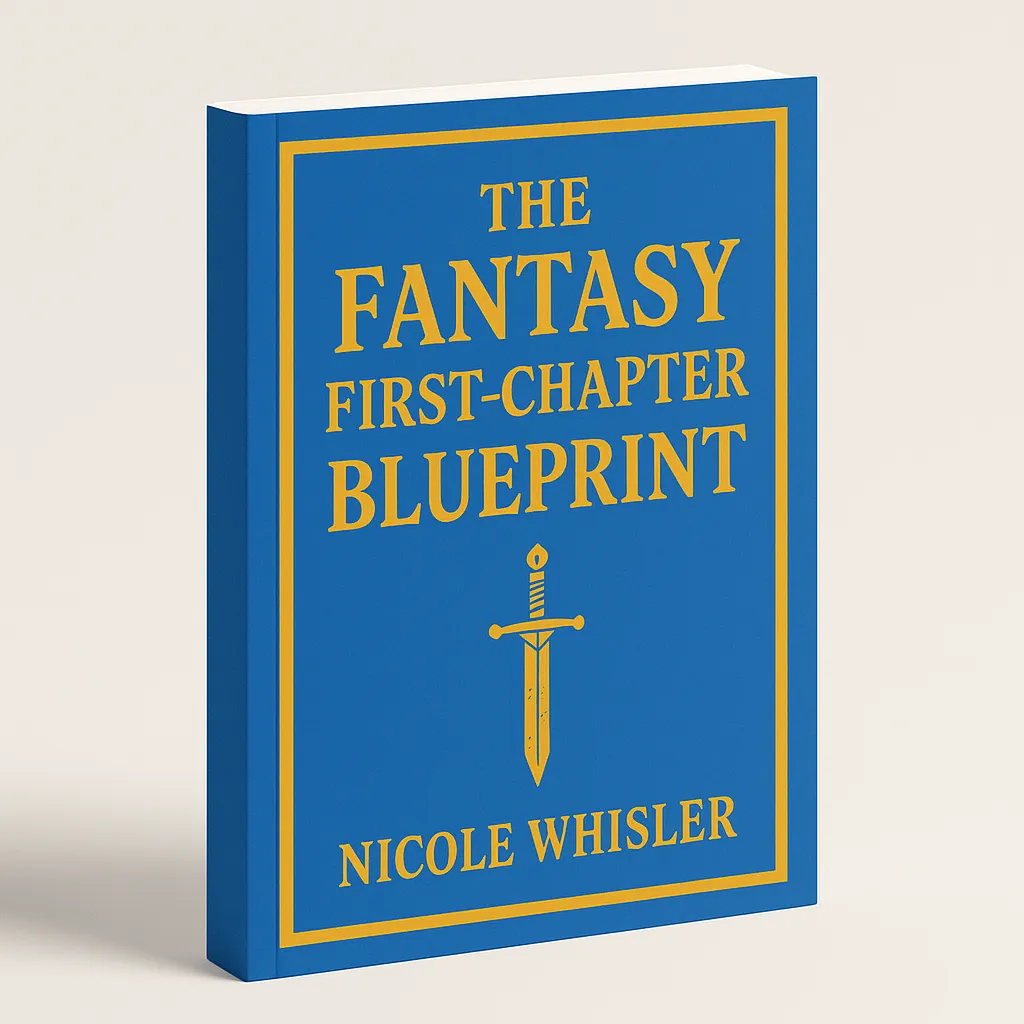
The Fantasy First-Chapter Blueprint
Your first chapter is your one shot to hook an agent or a reader. Don't let the 7 deadliest mistakes land your manuscript in the rejection pile. This free 7-day email course gives you the step-by-step blueprint to avoid them and craft an irresistible opening.

Your Novel Matters ...
Looking for the right book coach for your fantasy novel?
Are you a fantasy writer …
… struggling to convert the vivid scenes of your fantasy novel from your imagination to the page?
… stuck in a loop where you constantly rewrite your opening pages?
… worried your story won’t resonate with your readers?
What if I could show you the exact steps week to week that would take you from brainstorming and drafting to revising and publication?
I specialize in developmental editing and book coaching for writers of fantasy novels—writers who value the craft of storytelling and wish to create stories that resonate.
My Services
Develop Your Ideas
Fantasy Footsteps: Road to Publication
I’ll let you in on a secret. All you need to succeed as a writer are three things:
A Roadmap: Illuminate your path with a step-by-step guide, ensuring you achieve your writing goals every week. From outlining to publishing, every stage of your journey is mapped out for success.
Mindset Mastery: Learn how your thoughts control your outcomes in your writing. Overcome self-doubt and unearth the confidence that will bring your unique ideas to life on the page.
Personalized Support: Prepare for comprehensive assistance, real-time accountability, and feedback tailored to your needs. From brainstorming sessions to final publication, you'll have a dedicated ally guiding you every step of the way.
With these three pillars, you'll unlock the potential to:
Craft a captivating story that enthralls readers from the first page to the last.
Develop complex characters and immersive worlds that resonate deeply with your audience.
Navigate the complexities of plot twists and pacing, keeping readers hooked until the final chapter.
Receive specific guidance on refining your scenes so that readers root for your protagonist.
Overcome writer's block and stay motivated throughout your writing journey, ensuring consistent progress.
Transform your rough draft into a polished, professional manuscript ready for publication.
Are you ready to turn your fantasy novel from a mere vision into a masterpiece that captures hearts and minds?
Join Fantasy Footsteps: Road to Publication and begin your author journey with everything you need to write a story that works.
Don't let your story remain trapped in your mind—bring it to life with me!
If you’re thinking, “Yes, please! Tell me what to do!” , I’d like to invite you to work one-to-one with me to finish your novel and write a story that works. Join my book coaching program designed specifically for fantasy writers—Fantasy Footsteps: Road to Publication.

Discover Helpful Tools
Resources For Writers
Here you will find some of my favorite resources for writers.
Add these books, podcasts, websites, and other resources to your writing toolbox to augment your writing at any stage.
Join My Free, Private Facebook Group
Finish My Fantasy Novel: Write & Revise My Best Book in 6 Months
In the group, I go live weekly with writing tips. The group is also a platform for writers to support each other and share their wins and progress.
Live training schedule:
1st Tuesday of the month: Free critique for someone in the group!
2nd Tuesday of the month: Writing sprint with fellow writers
3rd Tuesday of the month: Live training on a specific topic
4th Tuesday of the month: Interview with an author or marketing/business expert


Improve Your Craft
Writing Advice Blog
As a developmental editor and book coach, everything I post is designed to help you build your creativity, strengthen your prose, and explore new avenues in your writing. The opinions in each post are my own, but many are inspired by ideas from established authors and editors who excel in their fields.
Rely on my blog for clear and specific writing advice, motivational tips and grammatical aid, and interviews with experts!
Hi! I'm Nicole.
I’m a Developmental
Editor & Book Coach for Fantasy Writers.
Like you, I'm a writer. I understand the mental and emotional ups and downs of storytelling. Don't let resistance win! Recognize the value of good advice plus hard work.
My approach to novel writing is multifaceted. For a deeper understanding of my process and style, take a look at some of my favorite craft-of-writing books in my Resources section.
What can I say about myself? I read, I write, I read about writing, and I write about reading. It never gets old to me.

See what writers like you are saying . . .

Nadir Shirazi
“I’ve been stalling on my Islam-inspired sci-fantasy series for 10 years. But within 10 minutes of starting Nicole’s program, I started writing again."

Amanda Emerick
“I can’t recommend Fantasy Footsteps enough to writers who are legitimately looking to polish their craft, write, and eventually publish their novel."

Trinity Cunningham
“I loved discussing my story with Nicole. She provided me with invaluable insights I never would have considered on my own."
Latest on the Blog

You will find no pictures of kittens here. No images of favorite dessert recipes, snapshots of my recent vacations, videos of puppies playing the piano (although I do love dogs), or YouTube clips of monkeys stealing people’s sunglasses.
I’m genuinely sorry if that disappoints you.
Instead, you can rely on my blog for clear and specific writing advice, motivational tips, grammatical aid, and author/editor interviews.
As a developmental editor & book coach, everything I post is designed to help you build your creativity, strengthen your prose, and explore new avenues in your writing. The opinions in each post are my own, but many are inspired by ideas from established authors and editors who excel in their fields.
Some of these tips might be just what you need to hear. Others might not work for you personally, and that’s okay.
Apply the tips that fit your personality and writing habits, and feel free to adapt or ignore the others. For further questions and comments, you can email me or reach me through my Contact page.

3 Core Principles My Most Successful Writers Follow
Discover in this post …
what to do when your writing schedule falls apart.
how to turn a missed writing goal into a strategic advantage.
how to test whether your focus is in the right place to get you real results in your writing.
My Novel Is Perfect So Far! (But I'm Stuck on Chapter 3)
Everyone wants to know the “secrets” of how to write and publish a novel successfully. They want to grab all the tips and gain all the knowledge.
So they watch YouTube videos, read books, listen to podcasts, and attend trainings on the craft. They seek to master dialogue, create strong hooks, and design the world’s most formidable villain.
Awesome! Now they know how to write a story that will engage readers. They’ve crammed all the information into their head, as if they’re studying for the world’s biggest final exam on writing and aiming for a perfect score.
But … does any of that matter if they don’t spend an equal (or greater) amount of time on the art of finishing a book?
After all, a “perfect” book that never makes it past the 75% mark won’t connect with readers—because it will never leave the writer’s computer.

That’s why with my book coaching clients, I focus not only on the craft of writing, but also on the mindset skills needed to actually complete the story.
They’re essential skills. And they’re often overlooked.
The writers who develop these skills are the ones who don’t just write excellent books—they finish and publish them as well. These writers get to hold their completed novel in their hands. They see their book on shelves in the library and at the bookstore. They host readings and book signings for eager audiences.
And it all starts with a willingness to work hard and master the basics.
I could list any number of mindset skills, but today, I’ll touch on three in particular that make a world of difference for my book coaching clients—and can do the same for you.
1 - Decide Ahead of Time
My clients aren’t superhuman. They’re just like everyone else.
Their cars break down.
They get sick.
Their kids need their attention.
They question their story ideas.
Their schedules change.
Their roofs need repair.
They host family for the holidays and try to balance everything at once.
You get the idea! Just like you, their life circumstances aren’t always in their control. And they’re aware of this.
But instead of thinking to themselves, “I wasn’t prepared for this job change at work! Now everything feels chaotic and I probably need to give up my writing goals for now,” they’ve already decided they’re pushing through and holding tight to their original dream of becoming a published author. If that means coming up with a new writing plan, so be it.
They’ve already decided that just like their day job, their writing life is nonnegotiable. If they stayed home from work for a week because of illness, they wouldn’t give up their job entirely. Same for writing: they’ve decided ahead of time that they’re not going to quit when they hit a snag.
They expect snags, and they’re prepared for them. They know why their writing is nonnegotiable to them.

Some of my clients were criticized as children and told they weren’t good enough, and they feel called to share a message of self-worth with readers: You are, and you have always been, more than enough. Others had a life-changing experience through a book they read as a teenager, and they’re bursting to replicate that feeling for others—they want readers to immerse themselves fully in their world and cheer and mourn along with the characters. Still others want to pass on their legacy and leave the strongest impact on the world that’s in their ability to give.
In each situation, my clients know exactly why their writing life isn’t optional for them, and they’ve consciously chosen to prioritize the daily habits and thoughts that will move them forward toward finishing their book.
They integrate their writing into their daily routines. They don’t wake up each morning and say, “I have an hour before work to write. Should I write or sleep?” They’ve already added their writing time to their calendars. They know the time of day that works best for them, they clear their schedule at that time solely for writing, and they throw everything they have into training their brains to understand that this is a priority. Then, as the days and weeks pass, because they’ve developed this habit, they’re much more inclined to follow through.
So if you’d like to prioritize your writing and decide ahead of time like my clients so you can get real results, here are the two biggest items you can decide right now if you’ve never done so:
Decide why your writing is nonnegotiable. Why is it not an option for you to let go of your dream?
Decide what you’re going to do when (not if) life circumstances “attack you.” What’s your plan to move forward in your writing no matter what roadblocks you encounter?
Jot down your specific answers to these questions, establish firm habits that work for you and your schedule, and be sure to return to your responses anytime you’re having a rough day or wonder whether it’s all worth it. Your past self knew exactly why it was a priority and may need to give your current self a pep talk.
2 - Treat Setbacks as Data
One of my coaching clients, Johnathan, has met or surpassed his 6,000-word writing goal every week for the past several months. A week ago, he finished his first draft! Each time we met, we celebrated all the color-coded green cells on his goal sheet that represented his success. We’re both incredibly proud of his accomplishment and the hard work that led him there.
But as I said above, my clients aren’t superhuman. As much as we’d like to meet our goals consistently week after week, it doesn’t always happen for every writer. Sometimes, because we’re human, we get blown off course.
And here’s my stance on that:
It’s not getting blown off course that matters most. It’s what you do when this happens that determines your new trajectory from that point.
If you decide that because you didn’t meet your writing goals for the past two weeks in a row, you’re a massive failure, that thought will follow you and interfere with your results. This is why it sometimes feels so difficult to regain momentum when you fall off track: not because you’re now attempting something “impossible” (as your brain might tell you), but because you’ve assumed a new, less certain identity (“If I failed before, I’m likely to fail again”).
But your past failures don’t need to hold any power over your future results.
If you didn’t meet your writing goals in the past, you’re actually more fully equipped now to meet your goal in the future—by looking at what went wrong and why.
This is why I have my clients evaluate their results on a weekly basis. If we know they fell short of their goal because they chose to play video games for a few hours instead of write, it’s much easier to make clear adjustments. They can see what went wrong, and they can see a solution. On the other hand, if they don’t think about why they didn’t write but just beat themselves up for not doing it, everything becomes more nebulous. “Just try harder next week” isn’t a clear plan because it doesn’t address the core issue.

How you view your “failures” changes everything. If you internalize a bad week and convince yourself that you are now a walking failure, you're shifting your core identity in a negative way, and getting back to the manuscript will only feel harder.
But what if in order to succeed, you first need to fail?
If you own your failures and mistakes, and you tell yourself, “This is normal, and I’m already making specific adjustments to get my desired result,” you’re signaling to your brain that you have the skills and ability to carve out a new path for yourself. You're cementing your identity as a writer who evaluates, adjusts, and keeps going. When you frame it this way, it's much easier to step back, see the big picture, and build a plan to get back on track.
You’ll also be able to see whether it makes more sense for you personally to make up the lost word count or simply to give yourself grace and start from where you are.
So remember these two crucial items:
It’s not getting blown off course that matters most. It’s what you do when this happens that determines your new trajectory from that point.
If you fall off course, identify exactly what happened and why. Focus on your game plan instead of beating yourself up. Remember that your favorite characters go through major obstacles to get what they want—and that just makes the victory all the sweeter.
If you’ve read my past blog posts and/or listened to my live trainings in my Facebook group, you’ll have heard me say that half the game involves learning not to believe what your brain first tells you. Our brains love to trick us! We acknowledge our initial thoughts and emotions, we ask ourselves what we’d like to think and feel instead, and we take action toward our goals according to the identity we’d like to create.
3 - Stay in the Present
Our past selves helped transform us into who we are today, and the future selves we want are well worth working toward. They each hold value. But getting trapped on either end doesn’t help us move the needle toward finishing the books we set out to write.
When we’re constantly focusing on the past—either yearning for the “good ol’ days” or berating ourselves for mistakes, as in #2 above—something shifts within us, and we’re no longer able to live fully in the present. We’re recollecting, visualizing, and sinking into the writer we used to be (“It was so easy for me to put words on the page at age fifteen. I just wrote my heart out and didn’t overthink it”), but we’re mourning the past rather than taking action in the here and now.
And that’s a problem because your “here and now” self is the one in charge of writing your book!
Something similar happens when we look to the future. When we’re wishing, dreaming, and imagining (“People will be lining up around the block for me at book signings. I’m going to be fully booked with author interviews. Readers will be screaming my name at international events”), we sometimes forget that it’s going to take hard work to get to that point.
To be clear, all three selves (past, present, and future) work together to push you forward on your author journey. But keep your main focus on your present self—the one responsible for writing the book.

Ask yourself two questions to see if you’re on track in this area:
Do I spend the majority of my time thinking about writing or actually writing? (Brainstorming is great as long as it leads to words on the page.)
Do I allow myself to enjoy the present? Instead of thinking, “I have to find time to write today to meet my goals,” what if you tried “I get to write today! This is a gift, and I can’t wait to get creative and make the most of it”?
Reflecting on the questions in the three sections above is the first step toward creating real change in your writing life and results, but the transformation isn’t usually instant or permanent unless you put in the work to make it so. To create new habits, we need to retrain our brains to see and accept the new thoughts as truth. Write your biggest takeaway on a note card, Post-it note, or your bathroom mirror—somewhere you’ll see it daily. Choose one or two new thoughts to focus on. Over time and with consistency, you’ll get results.
Which of the three principles above resonates most with you? Which do you already follow, and which do you want to work on as you move forward on your author journey? I’d love for you to email me at [email protected] and let me know!
Do you want to learn how to write a story that makes your target readers stand up and cheer? If you’d like support from A to Z (from brainstorming to drafting to revising to publication), book a Discovery Call with me to see if you’re a good fit to join my book coaching program,Fantasy Footsteps: Road to Publication. And if you haven’t done so already, grab your Free Guide on how to hook readers from your story’s start!

Capture Your Readers from Your First Scene
Get my exclusive blueprint—7 Mistakes to Avoid in Your Fantasy Novel’s Opening. Start your fantasy novel right!
Are you worried you've failed to establish a bond between readers and characters in your first chapter? Do you wonder if you've bogged readers down with your worldbuilding? Do you sometimes overlook essential conflicts? Many readers will put your book down if it doesn't grab their attention right away, so it's vital to evoke powerful emotions from readers as early as possible.
Don't let these common mistakes rob your story of its magic and momentum. Save your precious time and energy by ensuring you hook readers from the start. Grab your guide now and check your opening against these common missteps!
(You will also receive monthly writing advice, updates about my free live trainings, and direct access to replays. Unsubscribe anytime.)