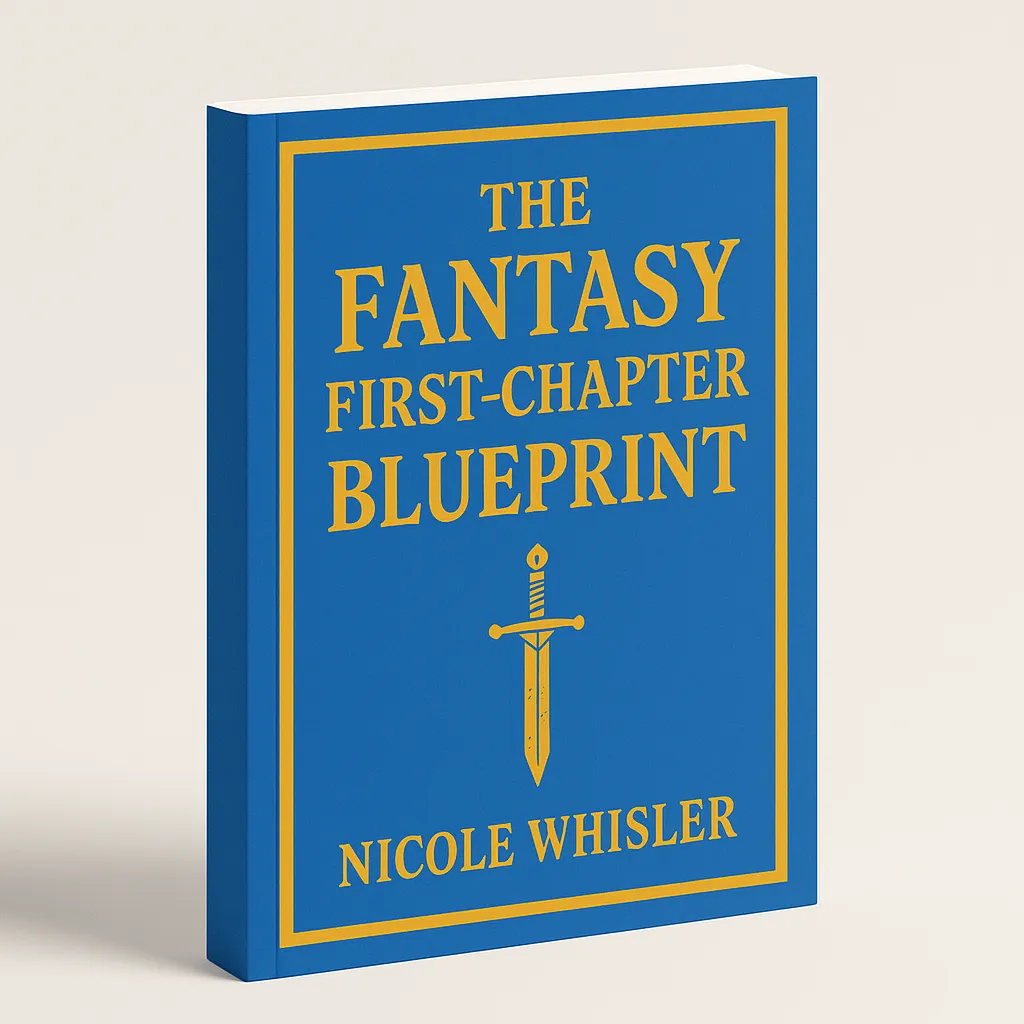
The Fantasy First-Chapter Blueprint
Your first chapter is your one shot to hook an agent or a reader. Don't let the 7 deadliest mistakes land your manuscript in the rejection pile. This free 7-day email course gives you the step-by-step blueprint to avoid them and craft an irresistible opening.

Your Novel Matters ...
Looking for the right book coach for your fantasy novel?
Are you a fantasy writer …
… struggling to convert the vivid scenes of your fantasy novel from your imagination to the page?
… stuck in a loop where you constantly rewrite your opening pages?
… worried your story won’t resonate with your readers?
What if I could show you the exact steps week to week that would take you from brainstorming and drafting to revising and publication?
I specialize in developmental editing and book coaching for writers of fantasy novels—writers who value the craft of storytelling and wish to create stories that resonate.
My Services
Develop Your Ideas
Fantasy Footsteps: Road to Publication
I’ll let you in on a secret. All you need to succeed as a writer are three things:
A Roadmap: Illuminate your path with a step-by-step guide, ensuring you achieve your writing goals every week. From outlining to publishing, every stage of your journey is mapped out for success.
Mindset Mastery: Learn how your thoughts control your outcomes in your writing. Overcome self-doubt and unearth the confidence that will bring your unique ideas to life on the page.
Personalized Support: Prepare for comprehensive assistance, real-time accountability, and feedback tailored to your needs. From brainstorming sessions to final publication, you'll have a dedicated ally guiding you every step of the way.
With these three pillars, you'll unlock the potential to:
Craft a captivating story that enthralls readers from the first page to the last.
Develop complex characters and immersive worlds that resonate deeply with your audience.
Navigate the complexities of plot twists and pacing, keeping readers hooked until the final chapter.
Receive specific guidance on refining your scenes so that readers root for your protagonist.
Overcome writer's block and stay motivated throughout your writing journey, ensuring consistent progress.
Transform your rough draft into a polished, professional manuscript ready for publication.
Are you ready to turn your fantasy novel from a mere vision into a masterpiece that captures hearts and minds?
Join Fantasy Footsteps: Road to Publication and begin your author journey with everything you need to write a story that works.
Don't let your story remain trapped in your mind—bring it to life with me!
If you’re thinking, “Yes, please! Tell me what to do!” , I’d like to invite you to work one-to-one with me to finish your novel and write a story that works. Join my book coaching program designed specifically for fantasy writers—Fantasy Footsteps: Road to Publication.

Discover Helpful Tools
Resources For Writers
Here you will find some of my favorite resources for writers.
Add these books, podcasts, websites, and other resources to your writing toolbox to augment your writing at any stage.
Join My Free, Private Facebook Group
Finish My Fantasy Novel: Write & Revise My Best Book in 6 Months
In the group, I go live weekly with writing tips. The group is also a platform for writers to support each other and share their wins and progress.
Live training schedule:
1st Tuesday of the month: Free critique for someone in the group!
2nd Tuesday of the month: Writing sprint with fellow writers
3rd Tuesday of the month: Live training on a specific topic
4th Tuesday of the month: Interview with an author or marketing/business expert


Improve Your Craft
Writing Advice Blog
As a developmental editor and book coach, everything I post is designed to help you build your creativity, strengthen your prose, and explore new avenues in your writing. The opinions in each post are my own, but many are inspired by ideas from established authors and editors who excel in their fields.
Rely on my blog for clear and specific writing advice, motivational tips and grammatical aid, and interviews with experts!
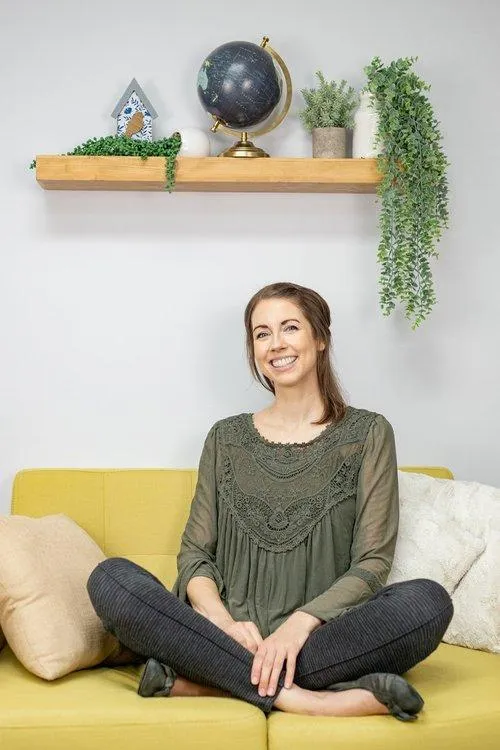
Hi! I'm Nicole.
I’m a Developmental
Editor & Book Coach for Fantasy Writers.
Like you, I'm a writer. I understand the mental and emotional ups and downs of storytelling. Don't let resistance win! Recognize the value of good advice plus hard work.
My approach to novel writing is multifaceted. For a deeper understanding of my process and style, take a look at some of my favorite craft-of-writing books in my Resources section.
What can I say about myself? I read, I write, I read about writing, and I write about reading. It never gets old to me.

See what writers like you are saying . . .

Nadir Shirazi
“I’ve been stalling on my Islam-inspired sci-fantasy series for 10 years. But within 10 minutes of starting Nicole’s program, I started writing again."
Amanda Emerick
“I can’t recommend Fantasy Footsteps enough to writers who are legitimately looking to polish their craft, write, and eventually publish their novel."
Trinity Cunningham
“I loved discussing my story with Nicole. She provided me with invaluable insights I never would have considered on my own."
Latest on the Blog
You will find no pictures of kittens here. No images of favorite dessert recipes, snapshots of my recent vacations, videos of puppies playing the piano (although I do love dogs), or YouTube clips of monkeys stealing people’s sunglasses.
I’m genuinely sorry if that disappoints you.
Instead, you can rely on my blog for clear and specific writing advice, motivational tips, grammatical aid, and author/editor interviews.
As a developmental editor & book coach, everything I post is designed to help you build your creativity, strengthen your prose, and explore new avenues in your writing. The opinions in each post are my own, but many are inspired by ideas from established authors and editors who excel in their fields.
Some of these tips might be just what you need to hear. Others might not work for you personally, and that’s okay.
Apply the tips that fit your personality and writing habits, and feel free to adapt or ignore the others. For further questions and comments, you can email me or reach me through my Contact page.

How 22 Writers Flesh Out Their Core Story Ideas
Discover in this post …
creative ways real writers flesh out their story ideas.
how different writers approach brainstorming and problem-solving.
simple strategies you can experiment with to find what works best for you.
Obsessed Much?
I flew home from teaching at the Novel-in-Progress Bookcamp in Racine, Wisconsin, the afternoon of June 27. My husband and three daughters wouldn’t be back from visiting the in-laws until the next day, so I had the house to myself for an entire evening—a rare occurrence.
I decided to relax and watch a movie. I flipped through options on Netflix and stopped at a logline that caught my attention:
A 36-year-old woman grieving the death of her boyfriend sees him again in another decade.
The show was A Time Called You, a Korean romantic mystery series. I had no idea where the story was going, but the premise sounded promising, so I watched an episode (I mistakenly thought it was a movie at first), then another.
And the rest is history.
I was hooked. I finished all twelve episodes within a week or two and couldn’t get the story out of my mind. I was obsessed with the concepts and characters—so obsessed that my mind, seemingly of its own accord, connected the TV show to a previous story idea I’d been playing with and ran away with it.

I hit the walking trail near my house—yes, that's the actual trail pictured!—and recorded voice note after voice note with ideas for my new story. (I've kept my New Year's resolution of going for a walk every day since January 1, and I've probably recorded 200 voice notes in the past few weeks alone.)
I listened back to those notes on the trail the next day to remind myself what I’d been thinking and re-immerse myself in the world I was creating.
And the plot started coming together.
I know how the story starts, I know how it ends, I know the midpoint, and I know most of the hooks in between. (Still working on my characters’ names—but small details, right?)
Now I have 15,000 words of notes that I’ve pasted into Scrivener. And it got me wondering whether some of the methods writers use to generate and expand ideas could help other writers, too. I’ve heard so many creative strategies from my clients that I decided to ask a handful to share what works for them.
Here are some of their favorite ways to build on a core story idea, generate new possibilities, and work through those inevitable moments when you’re not quite sure what happens next:
My Clients' Best Strategies for Expanding Core Ideas
1. Douglas Denga (Dark Fantasy)
I worldbuild in passes so that I don't get overwhelmed by it all. So I'll start with a quick pass at geography notes (physical features, weather), tack on a bit of how that affects the states of living or how it shapes the cultures around, then add in a bit of politics for how the governing power works.
I keep a few documents on my phone for these, and yes, they are messy, but they store all the random ideas I usually get at 3 a.m. mid-sleep or while out on walks.

What really helps me though, is those long-form, usually one- to three-hour-long science-based videos on YouTube and Netflix. They cover so much, from geography, cultures, religion, astronomy, you name it! Oral tradition from community members over here helps a lot too. I am in conversation with this wonderful lady who was around during the Mau Mau uprising in Kenya—she is quite advanced in years, nearly 90—but she is a storyteller and a half! I usually don't whip out my notes while we talk out of respect, but you should see me type everything down while heading home whenever I visit 😂. So just keep a notebook or tablet with you at all times is my advice! And search the world for inspiration! There are some pretty cool stories out there just waiting to be heard.
2. Katrin Tulev (Fantasy Romance)

I like to watch a K-drama or movie that’s similar to my story. Then I write down ideas for scenes. For example, in my current story I’m working on a body swap between a human and a fae. I watched a body swap K-drama and noticed they had scenes where the characters were floundering in their new roles. So, I created a scene where my fae character is having difficulty driving.
3. Sheng Chen (Epic Fantasy)

Sometimes staring at a blank page in my room can be as distracting as sitting in a pub full of singing drunks—which is why I love going for a run outside or taking a shower when I get stuck on certain ideas. I think it’s the subtle sound of rustling leaves or the pitter-patter of the shower droplets that gives the restless part of my brain something to feed on, so that the creative part can work in peace. It makes sense that the best ideas are often found in the shower. Activities like this provide just enough stimulation to the brain. They give my mind permission to wander. (Although after a while, I also found myself fighting the urge to take a shower every time I run into writer’s block, in case my water bill gets out of control.)
4. Kira Montana (Fantasy)
A. When I’m plotting, I’m always in writing mode. Meaning that I’m always on the lookout for ideas during my everyday life and I jot down everything I feel is remotely useful.
B. I visit museums. I love this one. It’s like watching the worldbuilding of our very own reality. In museums you have things displayed because they were important, and they tell you how, why, for who and how they influenced the present. It’s exactly the mindset you need for worldbuilding!
C. I read poetry. The imagery sometimes is so imaginative and unhinged that it sparks something new for me!
5. J.T. Henckel (Fantasy)

First, my greatest story ideas come randomly, often while driving long distances … and everything in Alaska is a long distance! Second, I like to head up into the mountains and sit … to feel the cold … to dip my hand into the icy water … to build a fire in the snow and to smoke my pipe. I like to envision what others felt exploring the wilds. And finally, I like to get up at three or four a.m. and start a fire in the fireplace, drink coffee, and write before the world—or my family—wakes.
6. Megan Caudill (Fantasy/Sci-Fi Superhero)

I have a brain dump of notes on my phone, where I throw ideas or dialogue or plot points constantly. Then (when I have time) I transfer them into Scrivener, either in specific scenes or an overall ideas subfolder.
7. NK Maness (Grimdark Fantasy)

No matter where I go, I keep a Dollar Tree notebook with me. They're small and fun-sized. I've been trying to do a little less with screens until it's time to type up the manuscript. Saves me from some headaches. I also feel like I can keep up with my outlines better this way. As far as ideas, they come and go with music. I'm not big on a lot of TV, but I am watching a show for research for a book idea a friend and I are concocting.
8. Rene Vecka (Fantasy)

I’m a cogitator when fleshing out a story. Meaning that I set the problem aside and go mow the lawn or some other menial task. Typically, ideas spurt through my consciousness, and while I’m riding back and forth, I assemble the puzzle pieces. For “simple” problems, that’s usually all it takes. For deeper issues, I have to sleep on it for several days and wait for my brain to present solutions. I have been woken up more than a couple of times. Pad and pen are in the nightstand. Every author must find the method that works best for them.
9. Sara Nagel (Fantasy)
I like to flesh out my characters (and really anything can be a character) by assigning them a primary and secondary archetype. I usually use the Greek Gods or other mythological figures as my archetype anchors to inject personality.
For the overall story I love listening to music and daydreaming—as well as challenging myself to be as wild and outrageous as possible with my ideas and then grabbing all the good stuff that comes out. Lately I’ve also been exploring with Tarot cards as narrative guides and character traits/motivations, but that’s still in its infancy.
10. Tom Barczak (Fantasy)

Be willing to write 15 min at a time. Anywhere. Any time. Any way.
Be willing to write badly.
I have three ways I typically start:
A. Listen for the dialogue between two or more voices. Let their words define their character. Then fill in the description later with increasing amounts of depth.
B. Start with a hyper-focused image, a narrow scene, hand touching a tree branch. The slow burn of a cigarette, the slow draw of a blade. The smell of sulfur from a fired gun. Focus only on the sound, the smell, all of the senses. Then follow with whatever emotions those things convey. Then surrender and allow yourself to fall into the scene whatever it unfolds into.
C. Build your world. Research. Imagine. Political role play. Sit quiet and look at the world around you and make note of what makes it real. Currency. Religion. Cuisine. Culture. Conflict. Humor. Landscape. Smells. Sounds. Demeanor.
11. Warner Onstine (Fantasy, Horror, & Sci-Fi)

Music/Songs - Some songs will spark a certain “feeling” for me, or a line will strike me and give me ideas on a potential “what if …” scenario that I’ll go off and explore.
Pictures - Some pictures I come across give me those vibes, or something someone says about a picture gives me an idea.
Stories/News articles/Strange unexplained things - I love hearing different stories from different cultures, news stories that are just strange that may spark something, weird, unexplained events.
Other creative stories - It's always fun when I come across another creator’s things that lead me into a new idea or something I hadn’t considered before.
Random stuff always crosses my path and I’ll try and make a note, or write down why it was intriguing to me and what about it I wanted to explore.
12. Johnathan Kircus (Fantasy)

What has been helping me a lot this past month is using an app called Mural. It allows you to have a free space to just jot down ideas and mind map. When I feel stuck, the mind map tool gives me a visual to see the different options and paths I can take. I jot down all scenarios and branch out each idea, fleshing out characters' goals, plot problems, or things I want to add to a specific scene.
13. Paul Underwood (Flash Fiction and MG Portal Fantasy)

My favourite way to flesh out a story idea is to begin with one small detail that catches my attention, then keep asking, ‘What if?’
I let the possibilities wander, often looking at the idea from another character’s perspective or imagining what might be hidden beneath the most obvious version of the story.
If I become stuck on a plot problem, I usually step away from the page and allow the characters to continue the story in my head, because quite often the answer arrives when I stop trying to force it.
14. Leslie Crowne (Romantic Fantasy)

My method for fleshing out story ideas progresses like this: I open a document and write down the premise or whatever initial ideas I have about the story. I get a lot of these, so some never make it past a few paragraphs! If it persists, I keep adding to it and when it "feels" like a viable story, I open another doc and write a rough outline—beginning, middle, end. Then when I'm ready, I start writing the text of the story in another document. At that point I also open a physical notebook where I free write my ideas on the story. I use that all through drafting to write what needs to happen in the next few scenes. I fill a notebook for each project. There is also a lot of lying around thinking about the story, or as you (Nicole) said, maybe if I am walking. As much mental work as physical typing!
15. Suzanne Rashed (YA Fantasy)

To flesh out story ideas, I step away to garden, do chores, or sit in my gazebo. When inspiration strikes, I email it to myself. Sleeping on it makes it easier to see the idea in black and white and decide what to keep.
16. Joy Corwin (Historical Fiction)

Sometimes, I simply go for a highway drive. I turn off the radio and focus on what particular issues I am working through in my narrative. This helps me with the larger issues—how to work out how my character arrives at a certain point, which parts of their backstory will account for a character flaw, or even how a fight scene must develop. On the highway, I am unlikely to be distracted or decide to go take care of some other chore or duty in my house.
For me, outside distractions have to be managed! If I am at home with others, I have to go to my desk in a room with no one else. If I am at home alone, I sit at the dining room table where I can have a view of the lake.
17. Hansford Hull (Fantasy)

I use a notepad on my phone. Whenever an idea, a few words, a lot of words, pop into my head, I take the time to jot them down. I do not follow the advice of those who will tell you "you'll remember it later." No, you won't! You will remember there was something important that you wanted to capture, but it is lost forever. When I am getting ready to start a new book or a new chapter, I print out all the notes I have created. I read the list through several times and then begin to write down what the names of the chapters will be. From the list, I move them into the chapter, adding the characters, the scene, and then allow my fingers to go to work. The most important part of it all, regardless of jotting it down or recording, is not to let your idea escape. Capture it for that moment where you feel it needs to be and allow it to tell its story. I, too, walk through a forest daily. It is a good time to look at my surroundings and allow my mind to wander.
18. Bader N. S. (Urban Fantasy/Sci-Fi)

Writing the plot details in bullet points helps me brainstorm freely and get ideas out before worrying about structure. Spending a weekend or a single night away alone also clears my mind by temporarily removing everyday responsibilities. I do it whenever I have a chance.
Walking outdoors, preferably around midnight when there are fewer interruptions, helps my thoughts flow.
Also, I try to live inside my characters: I imagine myself as the POV character, see the situation through their eyes, and ask what choice they would naturally make next.
19. Clarence Jennelle (Fantasy)

Visualization forms the core of my story-creation process. I often start by drawing the images in my mind onto paper to capture initial thoughts and emotions visually before diving into the mental and emotional depth. From there, my mind transforms into a movie screen where I witness the action unfold and deeply experience the full spectrum of emotions—the pain, angst, despair, and hope. This core image, real or imagined, is what I focus on for every scene, giving me a starting point to develop the rest of the story. I live the life of the character depicted in the picture for that scene.
20. David Flesher (Supernatural Horror)

Time away from my writing is very important. That is when ideas seem to just come to me, often when I’m watching television, or driving. When that happens, I will send myself a text message or email to be read later. I will then gather the several messages I’ve sent to myself and copy and paste them into a Word document that I keep in a file on my computer with all the other research and story notes.
21. Carolyn (YA Dystopian Fantasy)
One of my favorite ways to expand my story ideas is to listen to music and then I journal what I am feeling. Sometimes word formations or feelings pop off the page for me to put into my overall story.
22. David Grundy (Urban Fantasy)
People sometimes ask me where I get ideas for stories.

For me, the slightly frustrating answer is: they usually just show up.
I rarely sit down and deliberately decide, “Today I am going to invent a story.” More often, something simply wanders into my head—a character, a strange situation, a setting, a bit of dialogue, or a question that begins with What if?
What if someone discovered a door that opened into another time?
What if an ordinary person suddenly realized there was something very unusual about the town they lived in?
What if two people who had absolutely no business solving a murder decided to do it anyway?
Sometimes that first idea arrives surprisingly complete. I can almost see the characters and the direction of the story immediately. Other times, all I have is one tiny piece. It might be an interesting setting, a character with a peculiar occupation, a strange object, or a single scene that I know belongs somewhere in a book I haven't written yet.
That's when brainstorming becomes useful.
For me, brainstorming isn't necessarily about trying to force myself to have a brilliant idea. It's more like giving an idea room to play.
And quite often, I do that the old-fashioned way: with a pen and a piece of paper.
There is something about physically writing ideas down that works differently for me than simply thinking about them. I might put the basic idea in the middle of a page and start writing possibilities around it. Characters. Locations. Motives. Problems. Secrets. Random scenes. Bits of dialogue. Questions.
Sometimes I draw lines between things. Sometimes I circle an idea and branch three or four more ideas from it. Sometimes I make lists. Sometimes the page becomes a complete mess that probably wouldn't make sense to anyone but me.
That's perfectly fine.
The purpose isn't to create a neat outline. The purpose is to get the ideas out of my head where I can actually see them.
Once they're on paper, I can start playing with them.
I ask questions.
Who is this person? What do they want? What could go wrong? What would make the situation worse? Who else is involved? What secrets might these people be keeping? What happened before the story began? What is the most unexpected thing that could happen here?
And one question I find particularly useful: What if the obvious answer isn't the answer at all?
Do you use any of the above strategies yourself to generate story ideas? What’s your favorite, and what new method do you plan to try? I'd love for you to email me at [email protected] and let me know!
Do you want to learn how to write a story that makes your target readers stand up and cheer? If you’d like support from A to Z (from brainstorming to drafting to revising to publication), book a Discovery Call with me to see if you’re a good fit to join my book coaching program, Fantasy Footsteps: Road to Publication. And if you haven’t done so already, grab your Free Guide on how to hook readers from your story’s start!

Capture Your Readers from Your First Scene
Get my exclusive blueprint—7 Mistakes to Avoid in Your Fantasy Novel’s Opening. Start your fantasy novel right!
Are you worried you've failed to establish a bond between readers and characters in your first chapter? Do you wonder if you've bogged readers down with your worldbuilding? Do you sometimes overlook essential conflicts? Many readers will put your book down if it doesn't grab their attention right away, so it's vital to evoke powerful emotions from readers as early as possible.
Don't let these common mistakes rob your story of its magic and momentum. Save your precious time and energy by ensuring you hook readers from the start. Grab your guide now and check your opening against these common missteps!
(You will also receive monthly writing advice, updates about my free live trainings, and direct access to replays. Unsubscribe anytime.)