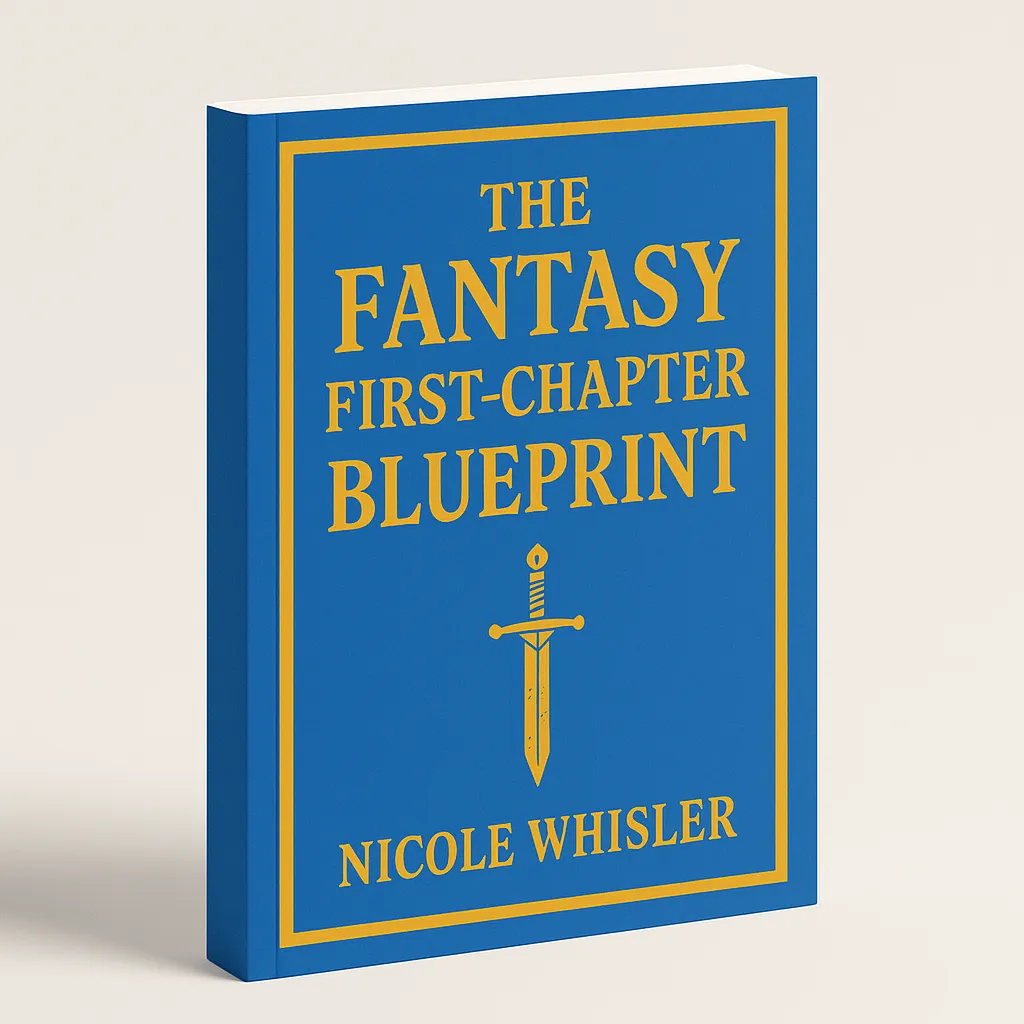
The Fantasy First-Chapter Blueprint
Your first chapter is your one shot to hook an agent or a reader. Don't let the 7 deadliest mistakes land your manuscript in the rejection pile. This free 7-day email course gives you the step-by-step blueprint to avoid them and craft an irresistible opening.

Your Novel Matters ...
Looking for the right book coach for your fantasy novel?
Are you a fantasy writer …
… struggling to convert the vivid scenes of your fantasy novel from your imagination to the page?
… stuck in a loop where you constantly rewrite your opening pages?
… worried your story won’t resonate with your readers?
What if I could show you the exact steps week to week that would take you from brainstorming and drafting to revising and publication?
I specialize in developmental editing and book coaching for writers of fantasy novels—writers who value the craft of storytelling and wish to create stories that resonate.
My Services
Develop Your Ideas
Fantasy Footsteps: Road to Publication

I’ll let you in on a secret. All you need to succeed as a writer are three things:
A Roadmap: Illuminate your path with a step-by-step guide, ensuring you achieve your writing goals every week. From outlining to publishing, every stage of your journey is mapped out for success.
Mindset Mastery: Learn how your thoughts control your outcomes in your writing. Overcome self-doubt and unearth the confidence that will bring your unique ideas to life on the page.
Personalized Support: Prepare for comprehensive assistance, real-time accountability, and feedback tailored to your needs. From brainstorming sessions to final publication, you'll have a dedicated ally guiding you every step of the way.
With these three pillars, you'll unlock the potential to:
Craft a captivating story that enthralls readers from the first page to the last.
Develop complex characters and immersive worlds that resonate deeply with your audience.
Navigate the complexities of plot twists and pacing, keeping readers hooked until the final chapter.
Receive specific guidance on refining your scenes so that readers root for your protagonist.
Overcome writer's block and stay motivated throughout your writing journey, ensuring consistent progress.
Transform your rough draft into a polished, professional manuscript ready for publication.
Are you ready to turn your fantasy novel from a mere vision into a masterpiece that captures hearts and minds?
Join Fantasy Footsteps: Road to Publication and begin your author journey with everything you need to write a story that works.
Don't let your story remain trapped in your mind—bring it to life with me!
If you’re thinking, “Yes, please! Tell me what to do!” , I’d like to invite you to work one-to-one with me to finish your novel and write a story that works. Join my book coaching program designed specifically for fantasy writers—Fantasy Footsteps: Road to Publication.

Discover Helpful Tools
Resources For Writers
Here you will find some of my favorite resources for writers.
Add these books, podcasts, websites, and other resources to your writing toolbox to augment your writing at any stage.
Join My Free, Private Facebook Group
Finish My Fantasy Novel: Write & Revise My Best Book in 6 Months
In the group, I go live weekly with writing tips. The group is also a platform for writers to support each other and share their wins and progress.
Live training schedule:
1st Tuesday of the month: Free critique for someone in the group!
2nd Tuesday of the month: Writing sprint with fellow writers
3rd Tuesday of the month: Live training on a specific topic
4th Tuesday of the month: Interview with an author or marketing/business expert


Improve Your Craft
Writing Advice Blog
As a developmental editor and book coach, everything I post is designed to help you build your creativity, strengthen your prose, and explore new avenues in your writing. The opinions in each post are my own, but many are inspired by ideas from established authors and editors who excel in their fields.
Rely on my blog for clear and specific writing advice, motivational tips and grammatical aid, and interviews with experts!
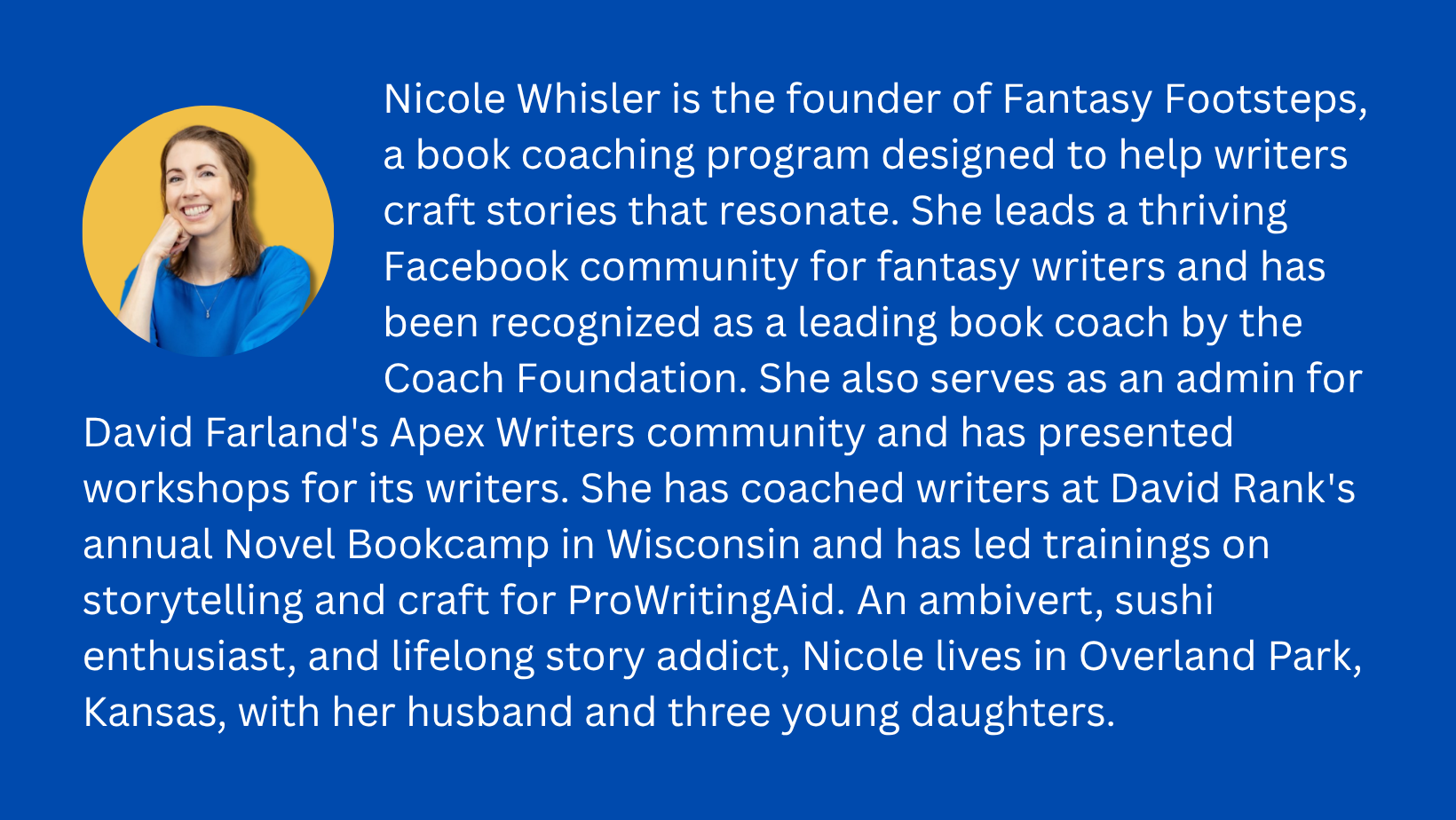
Hi! I'm Nicole.
I’m a Developmental
Editor & Book Coach for Fantasy Writers.
Like you, I'm a writer. I understand the mental and emotional ups and downs of storytelling. Don't let resistance win! Recognize the value of good advice plus hard work.
My approach to novel writing is multifaceted. For a deeper understanding of my process and style, take a look at some of my favorite craft-of-writing books in my Resources section.
What can I say about myself? I read, I write, I read about writing, and I write about reading. It never gets old to me.

See what writers like you are saying . . .

Nadir Shirazi
“I’ve been stalling on my Islam-inspired sci-fantasy series for 10 years. But within 10 minutes of starting Nicole’s program, I started writing again."

Amanda Emerick
“I can’t recommend Fantasy Footsteps enough to writers who are legitimately looking to polish their craft, write, and eventually publish their novel."

Trinity Cunningham
“I loved discussing my story with Nicole. She provided me with invaluable insights I never would have considered on my own."
Latest on the Blog

You will find no pictures of kittens here. No images of favorite dessert recipes, snapshots of my recent vacations, videos of puppies playing the piano (although I do love dogs), or YouTube clips of monkeys stealing people’s sunglasses.
I’m genuinely sorry if that disappoints you.
Instead, you can rely on my blog for clear and specific writing advice, motivational tips, grammatical aid, and author/editor interviews.
As a developmental editor & book coach, everything I post is designed to help you build your creativity, strengthen your prose, and explore new avenues in your writing. The opinions in each post are my own, but many are inspired by ideas from established authors and editors who excel in their fields.
Some of these tips might be just what you need to hear. Others might not work for you personally, and that’s okay.
Apply the tips that fit your personality and writing habits, and feel free to adapt or ignore the others. For further questions and comments, you can email me or reach me through my Contact page.

Is Your Fantasy Story Believable?
Discover in this post …
why believability matters more than strict realism in a fantasy world.
which five elements can help immerse readers and add depth to your overall concept.
how to test your characters, magic systems, and worldbuilding for believability.
That Would NEVER Happen
Have you ever read a fantasy book and thought to yourself, That would never happen? or I just can’t immerse myself in this world?
You find yourself losing interest in the story. Maybe you end up putting the book down altogether. You want to like it, but at the same time, you don’t want to force yourself to read something you’re not enjoying.
Now consider this from the writer’s perspective. I, for one, don’t ever want to hear that the tale I’ve written isn’t believable. I want to pull readers into my tale, not push them out of it.
Notice that I said believable, not necessarily realistic. As a fantasy writer, you’re not writing hard science fiction, where every detail must be explainable according to real-world principles.
But you do want readers to fundamentally believe in the story you’ve created. In a world that’s believable, characters spring to life from the page. Readers lose track of time, and the real world around them grows hazy. They stay up all hours of the night to finish the book and don’t mind the lack of sleep because the story is JUST. THAT. GOOD.

This is what most fantasy writers aim to create. Something meaningful. Something that leaves a lasting impact on readers. And it all starts with building the kind of world readers can lose themselves in.
So how do you add that level of believability to your fantasy manuscript? This doesn’t happen through luck but through careful planning, whether in the first draft or in the revision stage. Getting buy-in to your fantasy world can be as easy as getting buy-in to your characters’ desires and the situations they create ... if you tie them intimately together.
For those of you looking to test the believability of your story, look no further—here are five elements to evaluate in your own draft.
1 - Make Sure Each Character Wants Something in Every Scene
As a book coach, I often work with writers who successfully give their main character a clear goal, but they sometimes forget to apply this same concept to their side characters.
Your cast of characters should not be an extension of your hero, existing only for the hero’s needs. This will make the rest of your cast seem one-dimensional. As humans, we’re always thinking about what we want, whether the goal is big or small, and the same should be true for the characters we create.
To be clear, you don’t need to spell out every goal of every character on the page (sounds tedious and distracting, doesn’t it?), but readers should be able to infer your characters’ desires and intentions based on their conversations and actions. And those desires and intentions should align with the characters’ internal beliefs and motivations—because an out-of-character decision, action, or statement will pull readers straight out of the story.
Example

In The Fellowship of the Ring by J.R.R. Tolkien, think of the Council of Elrond scene, where each character enters with a different agenda. Boromir wants to protect Gondor, Aragorn wrestles with his lineage and responsibility, Legolas speaks on behalf of the elves, Gimli advocates for the dwarves, and Frodo increasingly believes the burden may fall to him. This scene feels alive because of the varying perspectives and worldviews. Nobody exists merely to support Frodo.
Believability Test #1
Pick a scene from your novel and make a list of every character in that scene. Ask yourself, What does each character want? Highlight the parts where you feel you’ve conveyed those desires to readers, either by stating them directly or implying them. (If a side character’s motivation is temporarily hidden from readers on purpose, that’s fine—but you’ll want to make sure the conversation and flow of the scene don’t feel too “easy.” Readers should sense there’s more to the story.)
Jot down any decisions characters make in your chosen scene and identify any beliefs they express. Are these decisions and beliefs aligned with those characters’ internal values? Why or why not?
If you’re worried your scene didn’t pass the believability test, that’s okay! This can easily happen when we haven’t taken the time to get to know our side characters, and this problem is fully fixable. If you think this is you, try interviewing your side characters so you can determine what they want and why. You’ll find them contributing to the story more meaningfully once you understand them better yourself.
2 - Have Characters Mention Off-the-Page Characters and Places
Many fantasy writers want to convey a vast secondary world to readers. They want it to feel big, not small. But how does that work? As a writer, can you even control the way readers picture your world in their heads?
Well, to some extent … yes.
If your characters only ever interact with or mention other characters on the page with them, the world will tend to feel small. And I mean really small—like a stage play where only the visible props and the actors currently standing under the spotlight exist. If the world feels like a closed movie set, readers can’t immerse themselves properly in the larger realm behind the scenes.
Characters should have natural reasons to mention other characters who aren’t in the scene with them. They should also mention places other than their current location. This is what people do in real life, and if your goal is to add depth to your world, this is what should happen in your story. But remember, everything you include should be needed by the core story, not included solely for the sake of believability. Readers won’t appreciate characters rattling off fifteen names of characters and places just to give the secondary world a “larger feel.” Often, selective detail is more valuable.
Example:
In Patrick Rothfuss’s The Name of the Wind, Kvothe constantly references people, legends, cities, songs, universities, rulers, and historical figures who never appear directly on the page. It makes the world feel ancient and inhabited. The book would lose a good amount of its depth if Kvothe only ever mentioned or thought about characters and places on the page with him.
Believability Test #2:
Pick a scene from your novel and highlight all the off-page characters and places mentioned. If there aren’t any, ask yourself, What does my character want and need in this scene? Who or what would my hero naturally be thinking about at this moment?
Identify the reasons you mentioned those characters and places. Is it purely to add depth, or does it fit the natural arc of the story itself?
3 - Establish Rules for Magic—and Follow Through
I’ve known fantasy writers who tend to get lost in the intricacies of the world they’ve developed and need me to push them forward into the actual writing part, and I’ve known writers who stay focused on the story itself and develop more of their world as needed.

In either case, it’s vital to follow through on the rules you’ve created around the magic (and to stay internally consistent in all other aspects of your world as well). How does the magic work? How does it affect the characters? What are the specific points in your story where it comes into play, and how do these rules drive your story and characters forward? If you break the rules you’ve established (let’s say you initially set a rule where anyone who steals magic from someone else temporarily loses their vision), readers will notice. Readers will also find it odd if you emphasize a certain rule at the outset but it doesn’t come into play later.
So make sure to weave your magical rules and system into the core of your story and use them!
Example:
In Brandon Sanderson’s Mistborn: The Final Empire, Sanderson establishes clear rules for Allomancy early. Different metals produce specific effects, power has limits, and each ability creates tactical consequences. Readers trust the magic because the rules stay consistent. When characters solve problems with Allomancy later in the story, the solutions feel satisfying rather than convenient or random because the groundwork already existed.
Believability Test #3:
Name every rule you’ve established about magic in your world.
Name every place those rules come into play and note two things:
Do you use the rule in some way later in the story, or will it seem like a loose end to readers?
Do you follow through on those rules and consequences?
Note that you don't necessarily need to explain your magic system to readers for it to be believable—Tolkien takes the opposite approach from Sanderson in keeping his magic system vague, which makes it feel more esoteric and mythical. But he balances this by involving it far less directly and frequently than Sanderson.
4 - Critique Your Story's Cause and Effect
It’s important to follow through with the rules of your magic system to make your story believable, but it’s equally important to follow through with cause and effect as a whole. In real life, decisions have consequences. Paying close attention to the ripple effects of your hero's actions will increase believability and strengthen your story’s arc.
All actions your hero takes should have clear consequences, whether positive or negative. After all, a story revolves around what a character wants and what they do to achieve that goal. Complications will escalate, and every choice your hero makes should move them closer to or farther from their desired outcome. If their choices don’t seem to matter (or even worse, if they don’t seem to make choices at all but are only pulled around by outer events), the story will be in danger of falling into the dreaded sequence of “This happens, and then this happens.” (If you struggle with this, check out my previous post on ensuring your story’s essence is strong.)
Example:
In A Game of Thrones by George R.R. Martin, Ned Stark’s decisions create devastating ripple effects throughout the story. He chooses to confront Cersei rather than act against her immediately, trusting honor and honesty to protect his family. That decision ultimately contributes to his downfall and throws the realm into chaos. The story feels believable because choices carry lasting consequences, and characters aren’t protected simply because they’re important.
Believability Test #4:
Pick a handful of scenes (ideally every scene if you’re already in the revision stage) and name every choice your hero makes.
Ask yourself, Do my hero’s choices move my story forward? What’s the clear consequence that happens as a result of each choice? Is my hero driving the story, or is the story only ever happening to my hero?
5 - Dip into Culture to Imply a Bigger World
Playing with cultural customs, traditions, and beliefs can be such a fun way to bring our fantasy worlds to life on the page. Part of what makes fantasy compelling is that it feels different from everyday life. Culture is one of the strongest tools we have to create that feeling.

When you’re creating your own fantasy culture, consider items like language, communication, art, food, clothing, celebrations, ethics, social norms, and belief systems. Then be sure those elements fit naturally into the story itself. No need to go deep into the history of a certain celebration, for example, if it won’t ever appear on the page. But give your brain some freedom to jot down notes without judgment. Then, when you have a spread of possibilities in front of you, you can work out which ones align with the story you’re telling and which will be a distraction.
Example:
In The Way of Kings, Brandon Sanderson uses cultural details to make the world feel lived in and distinct. Elements like safehands, eye color tied to social class, Alethi customs, food adapted to violent storms, and warfare shaped by geography all influence the characters’ everyday lives. The culture affects everything from fashion to social hierarchy to eating habits, and the world feels immersive, functional, and real to readers.
Believability Test #5:
How does your story’s culture differ from your own everyday life? And how does it distinguish itself from cultural elements found in other stories? Name key pieces of culture in your fictional world.
Highlight the exact places where you showcase those main elements of culture on the page. Ask yourself, How do these details fit with my hero’s needs and wants at this point in the story? Will they immerse readers or distract from the story itself? Am I including these elements because they’re vital, or is my sole reason to convey how cool my world’s culture is?
How did you do as you measured your current story against these five believability tests? Which of the elements do you feel is your strength? Which needs the most work? I would love for you to email me at [email protected] and let me know!
Do you want to learn how to write a story that makes your target readers stand up and cheer? If you’d like support from A to Z (from brainstorming to drafting to revising to publication), book a Discovery Call with me to see if you’re a good fit to join my book coaching program, Fantasy Footsteps: Road to Publication. And if you haven’t done so already, grab your Free Guide on how to hook readers from your story’s start!

Capture Your Readers from Your First Scene
Get my exclusive blueprint—7 Mistakes to Avoid in Your Fantasy Novel’s Opening. Start your fantasy novel right!
Are you worried you've failed to establish a bond between readers and characters in your first chapter? Do you wonder if you've bogged readers down with your worldbuilding? Do you sometimes overlook essential conflicts? Many readers will put your book down if it doesn't grab their attention right away, so it's vital to evoke powerful emotions from readers as early as possible.
Don't let these common mistakes rob your story of its magic and momentum. Save your precious time and energy by ensuring you hook readers from the start. Grab your guide now and check your opening against these common missteps!
(You will also receive monthly writing advice, updates about my free live trainings, and direct access to replays. Unsubscribe anytime.)